
|
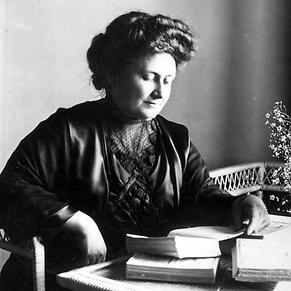
Dr. Maria Montessori, Founder of the Montessori Movement
|
|
|
Montessori Education
Build competence and intellectual curiosity through cooperative learning and discovery. |
|
"Never help a child with a task that he feels he can succeed (...) We must help the child act, think and will for himself. This is the art of serving the spirit." |
|
Maria Montessori
|
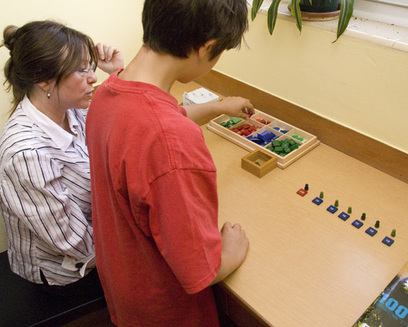
In the Montessori classroom this objective is approached in two ways: first, by allowing each child to experience the excitement of learning by their own choice rather than by being forced; and second, by helping them to perfect all their natural tools for learning, so that their ability will be at a maximum for future learning situations. The Montessori materials have this dual long-range purpose in addition to their immediate purpose of giving specific information to the child.
How the Children Learn The use of materials is based on the young child's unique aptitude for learning which Dr. Montessori identified as the "absorbent mind." In her writings she frequently compared the young mind to a sponge. It literally absorbs information from the environment. The process is particularly evident in the way in which a two year-old learns his native language, without formal instruction and without the conscious, tedious effort which an adult must make to master a foreign tongue. Acquiring information in this way is a natural and delightful activity for the young child who employs all his senses to investigate his interesting surroundings. 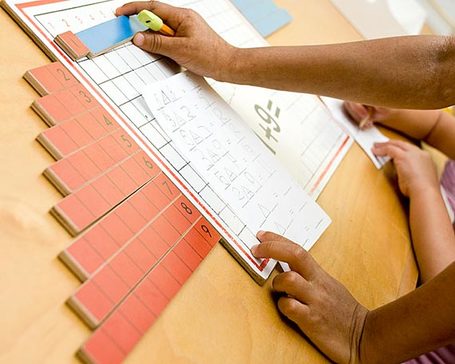
Since the child retains this ability to learn by absorbing until he is almost seven years old, Dr. Montessori reasoned that his experience could be enriched by a classroom where he could handle materials which would demonstrate basic educational information to him. Over 100 years of experience have proved her theory that a young child can learn to read, write and calculate in the same natural way that he learns to walk and talk. In a Montessori classroom the equipment invites him to do this at his own periods of interest and readiness.
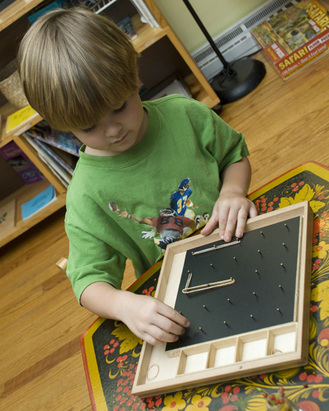
Dr. Montessori always emphasized that the hand is the chief teacher of the child. In order to learn there must be concentration, and the best way a child can concentrate is by fixing his attention on some task he is performing with his hands. All the equipment in a Montessori classroom allows the child to reinforce his casual impressions by inviting him to use his hands for learning. “No one can be free unless he is independent: therefore, the first, active manifestations of the child's individual liberty must be so guided that through this activity he may arrive at independence”
The Importance of the Early Years
In The Absorbent Mind, Dr. Montessori wrote, "The most important period of life is not the age of university studies, but the first one, the period from birth to the age of six. For that is the time when man's intelligence itself, his greatest implement is being formed. But not only his intelligence; the full totality of his psychic powers... At no other age has the child greater need of intelligent help, and any obstacle that impedes his creative work will lessen the chance he has of achieving perfection." Modern psychological studies based on controlled research have confirmed these theories of Dr. Montessori. After analyzing thousands of such studies, Dr. Benjamin S. Bloom of the University of Chicago wrote in Stability and Change in Human Characteristics, "From conception to age 4 the individual develops 50% of his mature intelligence; from ages 4 to 8 he develops another 30% ... This would suggest the very rapid growth of intelligence in the early years and the possible great influence of the early environment on this development." Like Dr. Montessori, Dr. Bloom believes "that the environment will have maximum impact on a specific trait during that trait's period of most rapid growth." As an extreme example, a starvation diet would not affect the height of an eighteen year old, but could severely retard the growth of a one year-old baby. Since eighty percent of the child's mental development takes place before he is eight years old, the importance of favorable conditions during these years can hardly be over emphasized. 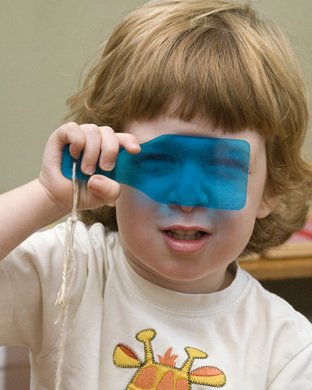
Sensitive Periods
Another observation of Dr. Montessori's, which has been reinforced by modern research, is the importance of the sensitive periods for early learning. These are periods of intense fascination for learning a particular characteristic or skill, such as going up and down steps, putting things in order, counting or reading. It is easier for the child to learn a particular skill during the corresponding sensitive period than at any other time in their lives. The Montessori classroom takes advantage of this fact by allowing the child freedom to select individual activities which correspond to their own periods of interest. At What Ages? Although the entrance age varies in individual schools, a child can usually enter a Montessori classroom between the ages of two and a half and four, depending on when she can be happy and comfortable in a classroom situation. She will begin with the simplest exercises based on activities which all children enjoy. The equipment which they use at three and four will help them develop the concentration, coordination and working habits necessary for the more advanced exercises they will provide at five and six. The entire program of learning is purposefully structured. Therefore, optimum results cannot be expected either for a child who misses the early years of the cycle or for one who is withdrawn before she finishes the basic materials described here. “We do not believe in the educative power of words and commands alone, but seek cautiously and almost without the child's knowing it, to guide his natural activity.”
Parents should understand that a Montessori school is neither a babysitting service nor a play school that prepares a child for traditional kindergarten. Rather, it is a unique cycle of learning designed to take advantage of the child's sensitive years between three and six, when she can absorb information from an enriched environment. A child who acquires the basic skills of reading and arithmetic in this natural way has the advantage of beginning their education without drudgery, boredom or discouragement. By pursuing their individual interests in a Montessori classroom, the child gains an early enthusiasm for learning, which is the key to them becoming a truly educated person.
|
"Montessori Madness"
|
|
|
|
Courtesy of Trevor Eissler, http://montessorimadmen.com
Maria Montessori Bibliography
|
The Montessori Method (1967), Robert Bentley Inc, Cambs, Mass, USA (The first book written by Montessori in 1909 when she was 38 - originally called The Scientific Method as Applied to Pedagogy, the title was changed when published in the USA three years later).Pedagogical Anthropology (1913) Heinemann, USA
Dr. Montessori's Own Handbook (1965), Schocken Books, New York, USA (first printed 1914, England 1920 - discussion on the use of the materials with photos) The California Lectures (1997), ABC Clio Ltd, Oxford, England (collected speeches and writings from 1915) Spontaneous Activity in Education: The Advanced Montessori Method, Vol 1 (1991), ABC Clio Ltd, Oxford, England (first printed in English 1917 theory and practice at the elementary level) The Elementary Materials: The Advanced Montessori Method, Vol 2 (1991), ABC Clio Ltd, Oxford, England (first printed 1917) The Child in the Family (1989), ABC Clio Ltd, Oxford, England (first printed 1936, American edition H Regnery Co, 1970) The Secret of Childhood (1972), Ballantine Books, New York, USA (Printed London 1936, New York 1939 - practical and theoretical introduction into the hidden psychic nature of young children plus the need for the spiritual preparation of teachers) Education for a New World (1994) ABC Clio Ltd, Oxford, England (first printed 1946 - the vital role that education plays in changing the world) The Child, Society and the World (1989), ABC Clio Ltd, Oxford, England (first printed 1946) The Discovery of the Child (1988), ABC Clio Ltd, Oxford, England (a revised edition of The Montessori Method as printed in Adyar, Madras, India 1948 - details the philosophy and techniques concerning the materials and the ways in which the children approach their work) To Educate the Human Potential (1989), ABC Clio Ltd, Oxford, England (Printed Adyar, Madras, India, 1948 - the needs of the elementary child regarding the acquisition of culture) From Childhood to Adolescence (1996) Clio Press, Oxford, England (first printed 1948 - the development of the child from age seven to adolescence) What You Should Know about your Child (1989) ABC Clio Ltd, Oxford, England (notes of lectures given in Ceylon, 1948) The Absorbent Mind (1988) ABC Clio Ltd, Oxford, England (First printed Adyar, Madras, India 1949 - Montessori's philosophy of child development from birth to three years plus her views on the role of teachers) Education and Peace (1995), ABC Clio Ltd, Oxford, England (first printed 1949 - essays including lectures from the 6th International Montessori Congress in Copenhagen in 1937) The Formation of Man (1989) ABC Clio Ltd, Oxford, England (Theosophical publishing House 1950 - also issued as Childhood Education - an approach to the issues of world literacy) |
A small selection of further Montessori resources & web links*

MariaMontessori.com
|

The Montessori Foundation
|
|
"Tomorrow's Child"
Read a free sample of the 20th Anniversary issue online
A Publication of The Montessori Foundation
(09/2012, Vol. 20, No. 4)
(09/2012, Vol. 20, No. 4)